
Syracuse's Directory Collections
The known Syracuse city directory trail is spread across Utah collections rather than one verified local run. Marriott's Utah City Directories collection offers year, publisher, and place filters, with PDFs and metadata. FamilySearch provides the Utah, Davis County Records, 1869–1953 image collection and displayed 40,381 browse images during research. The Davis County Library Syracuse Branch is a practical reference stop, but its public location page does not publish a complete city-directory, reverse-directory, telephone-book, or obituary year list.
| Collection | Years | Where Held | Access |
|---|---|---|---|
| Utah City Directories collection | Visible facets include 1867–1989 | Marriott Digital Library | Search metadata and PDFs |
| Utah, Davis County Records | 1869–1953 | FamilySearch | Browse images, index varies |
| Syracuse reference collection | Exact run not published | Davis County Library branch | Reference, scan, interlibrary loan |
| Historic building records | 28 Syracuse records | Marriott Digital Library | Address and building metadata |
Those dates describe collections and visible facets, not a promise that every year includes Syracuse. Examples in the research include R.L. Polk volumes for nearby Ogden suburban regions in 1933–41 and 1975–79, but the exact Syracuse coverage is not established. Treat missing years, publication changes, and gaps as research questions. Ask a librarian for the title, edition, publisher, and shelf or scan location before citing a year.
Syracuse Library Reference Route
The Syracuse Branch is at 1875 W 2000 S and lists a reference desk, interlibrary loan, photocopying, digital scanning, public internet, Wi-Fi, and meeting rooms. It opened in August 2003 with about 30,000 items, closed for expansion in October 2018, and reopened in November 2019. The service area includes Syracuse, Clinton, West Point, and western Layton and Clearfield.
Ask for a dated directory or reverse lookup, a newspaper obituary search, a yearbook or alumni source, microfilm, and any licensed historical database. The public library page does not confirm exact holdings. A useful reference request includes a surname, street variant, date range, and the question the volume should answer. Record the librarian's catalog result even when the answer is that no local run was located.
Use the Davis County Library locations page to confirm the Syracuse branch and its public research services.
Those services are the bridge when a city directory is not fully digitized.
Utah Digital Directory Shelves
Marriott's digital city directory collection is the most direct online route. Directory volumes can be arranged by publisher, year, place, and collection metadata. A scan may cover several Utah cities, so a Syracuse search should inspect the title, geographic scope, and page image rather than assume a hit is a Syracuse address. Search names with spelling variants, then test the street section when an alphabetical result gives an address.
FamilySearch's Davis County image collection is different. Its 1869–1953 span joins courthouse books, vital material, naturalization, land, and cemetery images, but the displayed image count does not guarantee a name index for each page. Use the collection as a page-level archival route. A file name, volume label, image number, and the neighboring page can matter when OCR or a name index is absent.
Open the Marriott Utah City Directories collection to use its year and publisher filters.
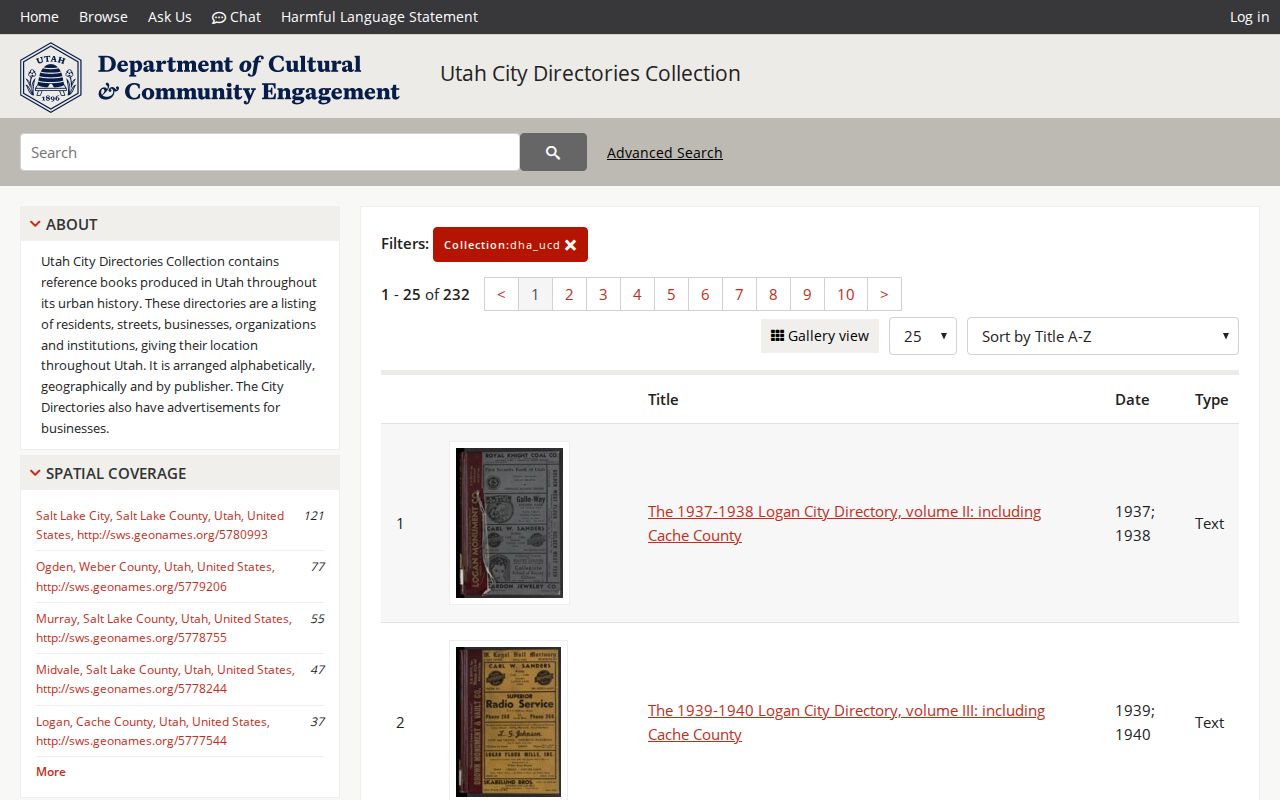
Those filters make a city directory search reproducible.
Read a Syracuse Directory Entry
A city directory entry is compact. Read each mark as a field, and check the volume's own abbreviation key before expanding it. A name can identify a head of household or a spouse in parentheses. An address can place a person on a street for one year. A widow notation can mark a family transition. A business line can reflect a workplace address rather than a home. An owner mark, when used by that publisher, is a symbol to record, not a fact to carry into every year.
| Entry field | What it records |
|---|---|
| Name | Head of household; a spouse may appear in parentheses. |
| Occupation | Trade or occupation, sometimes with an affiliated firm. |
| Address | House number and street; abbreviations can mark residence or boarding. |
| Owner mark | A publisher's symbol for ownership when that volume uses one. |
| Widow notation | A family-status note, such as “wid Charles,” useful for genealogy. |
- Criss-cross section
- The street-order half of a later directory, moving from address to person.
- Householder index
- An alphabetical name aid that points to a household entry or address.
- Abbreviation key
- The volume's legend for short forms and symbols. Capture it before reading entries.
28 Syracuse Buildings in Marriott
The Marriott Utah Historic Building Records filter returned 28 Syracuse records with named or addressed buildings. Examples include the Hodgson Roy and Louise House at 256 S 2000 W, Kay William Cabin at 977 S 3000 W, and several named houses on W 1700 S. These are historic-building records, not a full owner or resident list. Their value is the bridge from a place name to a parcel, newspaper search, museum file, deed description, or directory page.
Use a building name as a cross-check term. Search it with Syracuse, a surname, a street variant, and the likely period. Then compare the historic address with the modern parcel's legal description. A named building can connect a family to a place without proving that the same family occupied it in every year.
Open the Marriott Syracuse historic-building filter to see the named-address bridge.
Use the metadata as a lead, then verify with the current parcel and local archive.
Syracuse Newspapers Fill Directory Gaps
Utah Digital Newspapers supplies a different kind of historical search. OCR can find a surname, street, business, obituary phrase, civic event, or the name of a local group. Search Syracuse and Davis County together, then try Clearfield, the street variant, and the surname without punctuation. OCR can misread names, so open the page image and record the date, paper, page, and neighboring text.
The newspaper route works well beside a city directory. A directory places a person at an address for a dated volume. A newspaper can explain a move, death, civic role, military service, business, or family connection. Syracuse history references sugar beets, the 1898 canning factory, the wartime depot, and the partly Syracuse POW camp, providing precise search terms rather than generic local color.
For a final family check, ask the museum about its pioneer and descendant index, Rentmeister books, and oral-history equipment. Ask the library about yearbooks, microfilm, interlibrary loan, and obituary searches. Neither public page confirms a complete local obituary index or exact directory run, so retain the reference desk's answer as part of the research record.
Syracuse Directory Research Timeline
A timeline keeps collection dates from being mistaken for a continuous Syracuse publication run. These are the useful markers located in the research:
- 1867: Marriott's Utah collection includes a sample Salt Lake City directory, showing the kind of early multi-city volume a researcher may encounter.
- 1869–1953: FamilySearch's Davis County image collection bridges county books, though image coverage and name indexing vary by series.
- 1933–1941: R.L. Polk examples cover nearby Ogden suburban regions, a reminder that a regional title may not be a Syracuse title.
- 1975–1979: Later R.L. Polk examples show publisher and regional coverage changes in the digital collection.
- 1989: Visible Marriott city-directory facets extend to this year, but the research did not verify a final Syracuse-specific printed volume.
The dated markers help plan a request. A missing Syracuse entry may require another publisher, a street section, a newspaper, or a library interlibrary-loan search.
Trace Syracuse Directories Through Family
Tracing a household with a city directory works best as a dated table. Note the exact name, address, spouse or widow mark, occupation, publisher, and page. Follow the entry forward, but do not treat an absence as a death. A move, a missed volume, an unlisted person, a business address, or a spelling change can all break the run. Census years add a separate household snapshot, while deeds show land relations rather than every occupant.
- Find the earliest plausible name in a dated volume and capture the full entry and page.
- Follow the name forward, keeping spelling, spouse, address, and publisher changes in separate columns.
- Use the street or criss-cross section to test the address and nearby entries.
- Pair directory years with the matching census and compare household size, age, and place.
- Use Utah Digital Newspapers, Syracuse Memorial Park, probate, or museum family-history records to explain a final appearance.
A useful final check is the Syracuse Regional Museum. Its family-history index, pioneer and descendant documentation, Rentmeister Book Collection, and Rentmeister Reading Room connect names to oral histories and local books. Call or email before visiting. The museum is an appointment and reference service, not an unrestricted online directory.
Davis Records Behind the Directory
Davis County was organized in 1850, and the county clerk's predecessor served as the primary county record keeper before statehood changed the title in 1896. The recorder says historical land records begin in 1870, records were safeguarded from 1850, and computerization and microfilming began in 1981. These dates explain why a modern city directory search may need county books or image collections to bridge its gaps.
One local preservation story is especially useful. A USHRAB project unfolded, scanned, and rehoused about 2,800 1869-era oaths and bonds. Search archival descriptions by creator, series, date, and format. The story is a reminder to ask for a record series and image, not merely a name search. No verified first or last Syracuse-only directory year was located in the official source pass.
Reading rule. A city directory date fixes a record in time. It does not prove ownership, legal residence, or a complete household. Pair the entry with a parcel, census, newspaper, cemetery, or court source.